
MemoryVault
Privacy-first encrypted knowledge vault for notes.
Awards
The problem it solves
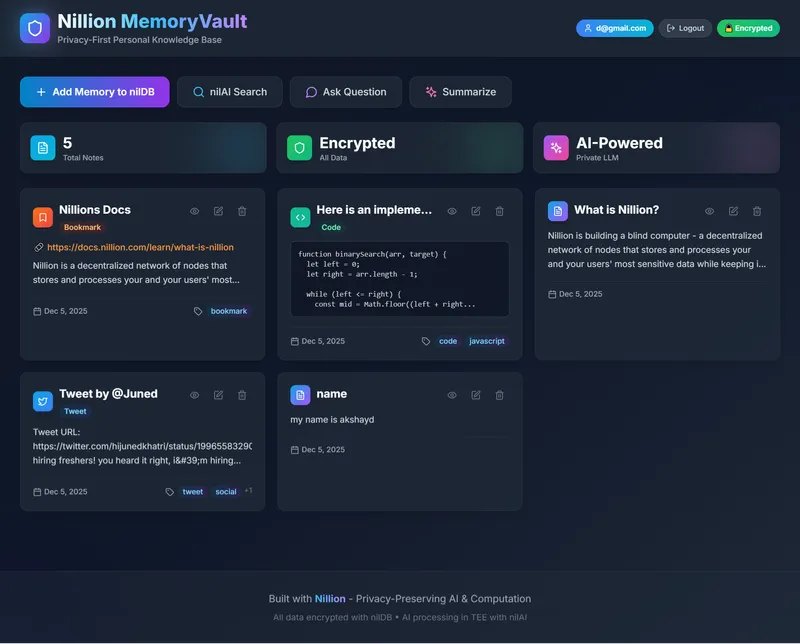
Nillion MemoryVault is a privacy-first personal knowledge base that addresses privacy and security concerns when storing and processing personal information.
Core Problems Solved:
-
Privacy-preserving storage: Notes, memories, code snippets, bookmarks, and documents are encrypted at rest using Nillion’s nilDB. Data is stored in a distributed, encrypted format where operators cannot see plaintext.
-
Private AI processing: AI features (search, Q&A, summarization) run in Trusted Execution Environments (TEEs) via nilAI. Queries and computations remain private—operators cannot see your queries or data.
-
Secure knowledge management: Store sensitive information (personal notes, job opportunities, research, ideas, code snippets, bookmarks) with confidence that it remains private and encrypted.
-
User data isolation: Email/password authentication ensures each user only sees their own notes. Data is isolated per user using Nillion’s decentralized identity (DID) system.
Use Cases:
- Personal knowledge base: Store and organize personal notes, ideas, and research
- Private journaling: Keep private thoughts and memories encrypted
- Research notes: Store research with AI-powered search and summarization
- Developer code library: Save code snippets with syntax highlighting and language detection, accessible privately
- Tweet/bookmark saving: Save tweets and bookmarks with full content preservation
- Question answering: Ask questions about your stored knowledge using private AI
How It Makes Tasks Easier/Safer:
- Zero-knowledge architecture: Your data is encrypted end-to-end; even service operators cannot access it
- AI-powered without privacy trade-offs: Get AI search, summarization, and Q&A without exposing data to third parties
- User-owned data: You control your data with selective sharing capabilities
- Secure by default: All operations use encryption and TEEs automatically
Challenges we ran into
Challenge 1: Module Initialization Conflicts
Problem: @nillion/nilai-ts bundles its own @nillion/nuc, causing conflicts when importing both @nillion/nuc and @nillion/secretvaults in Next.js. This led to runtime errors like TypeError: Cannot read properties of undefined (reading ‘add’).
Solution: Switched to dynamic imports for nilAI functions to defer module loading and prevent initialization conflicts. Instead of static imports at the top of files, I used await import(‘@nillion/nilai-ts’) inside functions to load modules only when needed.
Challenge 2: Circular Dependency in Authentication
Problem: A circular dependency between getNillionClients() → getUserSignerForAuthenticatedUser() → getUserById() → getNillionClients() caused the /notes API endpoint to hang indefinitely in a pending state.
Solution: Refactored getUserById() to create its own builder client directly instead of calling getNillionClients(), breaking the cycle. Added timeout handling to prevent indefinite hangs and provide better error diagnostics.
Challenge 3: User Lookup with Owned Collections Problem: The users collection was created as owned, which made listDataReferences() fail with 401 Unauthorized errors. Users couldn’t log in after registration because the system couldn’t find their accounts.
Solution: Implemented a deterministic UUID v4 generation from email hashes, allowing direct lookup via getUserById() instead of listing all references. This eliminated the need for listDataReferences() on owned collections and resolved authentication issues.
Gallery


